


LABORATORY OF FUNCIONAL MORPHOANATOMY OF PLANTS
Laboratory of Functional Morphoanatomy of Plants
In June 2021, the Laboratory of Functional Morphoanatomy of Plants (LAMOF) was officially inaugurated. Although still very small, our lab strives to understand the importance of the myriad of morphoanatomical traits to the survival of plants.
One of our interests is to understand the correlation between the morphoanatomical structure of plants and the habitat where the species live in. Such traits may be related to biotic or abiotic environmental factors as plants are biological systems that are in constant negotiation with such environmental factors. Although our studies are more focused on semiarid species, especialy the Caatinga, this is not the only biome under study by the LAMOF team.
We also try and use the plant anatomy as a tool applied to the taxonomy and phylogeny. We search for morphoanatomical characteristics that are constant, that is, that do not vary according to the environment, in a way to use such characteristics in taxonomical studies.
And finally, but not least, plants may present an array of secretory structures such as nectaries, trichomes, elaiphores, osmophores, laticifers, colleters, among others. These structures have many different ecological roles on the plant body. Our lab is also interested in unraveling the morphoanatomical complexities of plant secretory structures structures and their importance for the plants fitness.
News
NEW ARTICLE: Soil–climate interactions drive above‑ground biomass in the Caatinga, the largest Neotropical seasonally dry tropical forest
Posted on November 29, 2025
Our study reveals the interactions between climate, soil, and vegetation in the FTSS of the Caatinga. The multi-model approach and the structural equation model showed that average annual precipitation, nutrient availability, and the interaction between climatic and edaphic factors are determinants of aboveground woody biomass. Soils with higher cation content strongly influence community-weighted functional attributes and functional richness, reflecting in greater productivity. More favorable soil conditions and higher precipitation result in greater biomass accumulation. Despite limitations such as the reduced number of samples, the study improves the understanding of how functional attributes regulate biomass and contribute to predicting changes in ecosystem states, with relevant implications for biodiversity conservation and carbon sequestration in dry tropical regions.


SECO: Resolving the current and future carbon dynamics of the dry tropics
Posted on December 13, 2024
SECO is a research project funded by NERC that will generate the first ever estimates of key carbon fluxes across the dry tropics. Collaborators from more than 20 countries will use data from over 600 forest and savanna plot, radar remote sensing and modelling to understand how the vegetation of the dry tropics is changing.

SECO Project
We are very proud to be a part of this bold project!!! SECO is a research project funded by NERC that will generate the first ever estimates of key carbon fluxes across the dry tropics. Collaborators from more than 20 countries will use data from over 600 forest and savanna plot, radar remote sensing and modelling to understand how the vegetation of the dry tropics is changing. Outputs from this project will inform the global carbon budget and global vegetation modeling, which are crucial to better understanding climate change.
The effects of desertification on the biodiversity of plants bearing extrafloral nectaries and their interactions with nectarivorous ants.
The Caatinga covers ~730 thousand km2 of Brazilian territory and currently has 80% of its vegetation impacted by extractivism and agriculture Such activities have been generating changes in the Caatinga that lead to areas experiencing desertification which reduces the abundance, number of species and diversity of plants, modifying the animal communities that depend on these primary producers. Ant communities are an example, as they maintain associations with plants with extrafloral nectaries (EFNs). NEFs comprise an indirect defense for plants, they secrete nectar (sugar solution), which is the main reward for the services provided by ants that interact with the plant, providing protection against herbivores. As desertification reduces the diversity of plant species, there may be a reduction in the diversity of extrafloral nectar offered to ants. Thus, our hypothesis is that desertification reduces the diversity of nectar (types of nectar with different compounds) being offered to ants, which directly impacts the diversity of nectarivorous ants visiting species with NEFs.
"O efeito da desertificação na biodiversidade de plantas portadoras de nectários extraflorais e suas interações com formigas nectarívoras (Chamada CNPq/MCTI No 10/2023 - Faixa A - Grupos EmergentesProcesso: 407358/2023-4.)


Morphoanatomical contributions on the resolution of taxonomic issues in Senegalia Raf.
Senegalia Raf. is a genus of the “Clade Mimosoideae” (Leguminosae) with ~200 species out of which ~100 species occurrs in the Americas, especially Brazil. Certain species of this genus are difficult to be recognized, mainly due to the overlapping of morphological characteristics, such as: number of pairs of pinnae, leaflet shape and morphology of extrafloral nectaries. The consequence of this overlapping of characters is the occurrence of species complexes.
The taxonomic delimitation of species complexes is still difficult due to the lack of phylogenetic and biogeographic data on these species. In cases where external morphology presents overlapping patterns of variation, morphoanatomical characteristics have been used as additional tools useful in the segregation of closely related species. Thus, this project aims to carry out the leaf morphoanatomical description of species from different complexes, emphasizing the distinctive characters of these species, thus adding data that assist in the delimitation of these species.
PhenoChange membership meeting
Posted on December 10, 2024
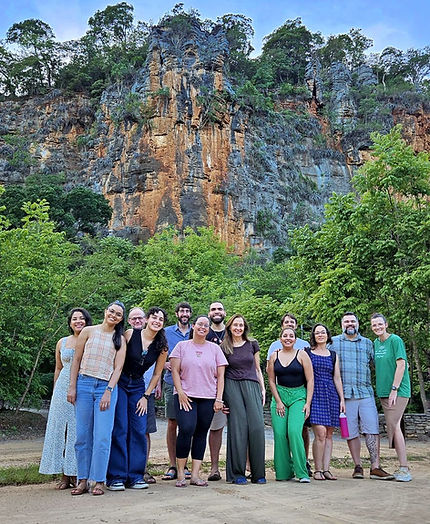
This week, LAMOF is in Cavernas do Peruaçu National Park. Prof. Ítalo is participating on membership meeting of the PhenoChange Project, a transcontinental network for monitoring phenology in dry vegetation in the tropics. The project aims to understand the variables that control vegetative phenology and the flows of matter and energy associated with it. The results of this project will be useful in modeling Earth systems, especially for tropical dry vegetation, helping to project vegetation responses to climate change. The project makes massive use of remote-near phenology technologies, such as the use of repeated images from digital cameras, phenocams.
Under the supervision of LAMOF are the areas in the RPPN Serra das Almas, where doctoral student Mirelle Marques develops her thesis.
Useful Links


Programa de Pós-Graduação em Sistemática, Uso e Conservação da Biodiversidade


